
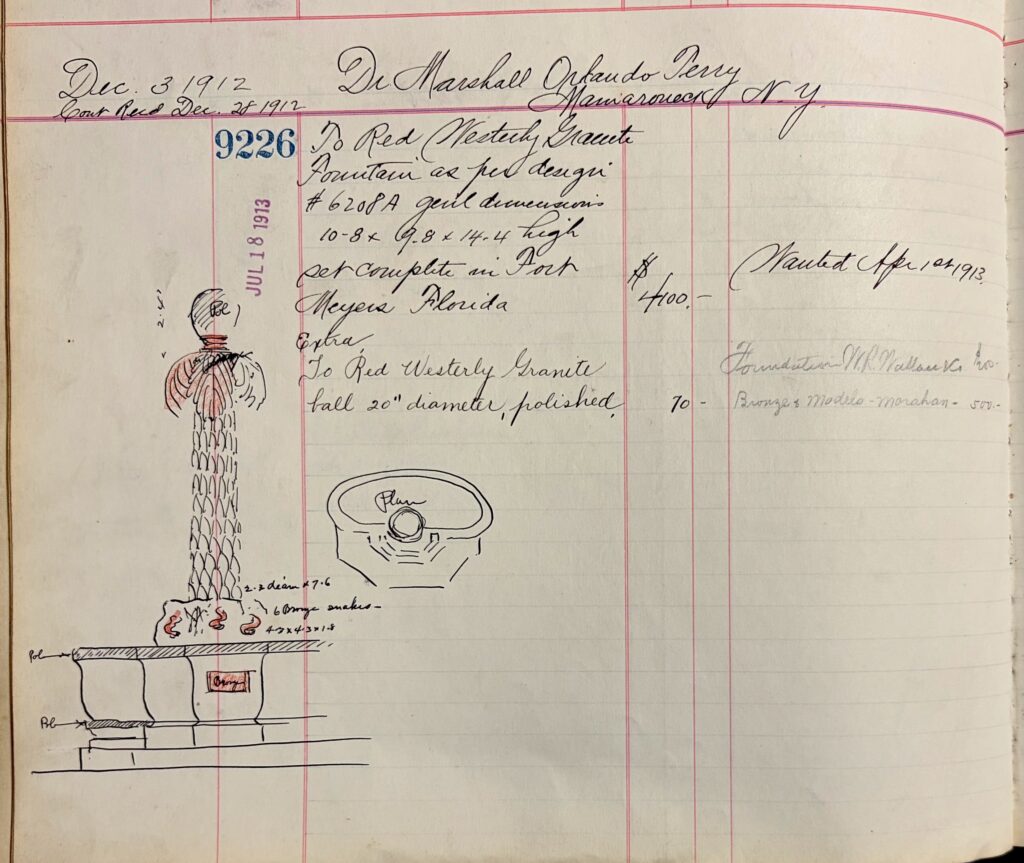
New England Granite Works order book 10, page 114, order 9226 placed by Dr. Orlando Marshall Terry on 3 December 1912 and shipped on 18 July 1913 at a cost of $4,170.00. It was cut from Westerly Red granite.
When John Linton was reviewing one of the New England Granite Company’s order books, he found a watering trough, now named the Tootie McGregor Fountain, in Fort Myers, Florida. It was their first public artwork, thought to be made from Georgia granite and was located downtown at Five Points. It was removed to make room for the Caloosahatchee Bridge and was put into storage. In 1982 it was restored and placed outside of the Edison Restaurant at the Fort Myers Country Club.
Brenda Linton’s brother, Forrest Banks, lives in Fort Myers and she asked him to take a picture of it for the Smith Babcock Granite Archives. He did and its story inspired him to create a program for the South West Florida Historical Society given in September of 2026. His text and pictures follow.
Tootie McGregor Fountain by Forest Banks Presented to the Southwest Florida Historical Society on 10 September 2026
Late last year my sister, Brenda Linton, a retired schoolteacher in Westerly, RI, sent me a note and asked me to take a picture of Tootie McGregor’s Monument. So, off to Fort Myers Country Club I went and took this picture.
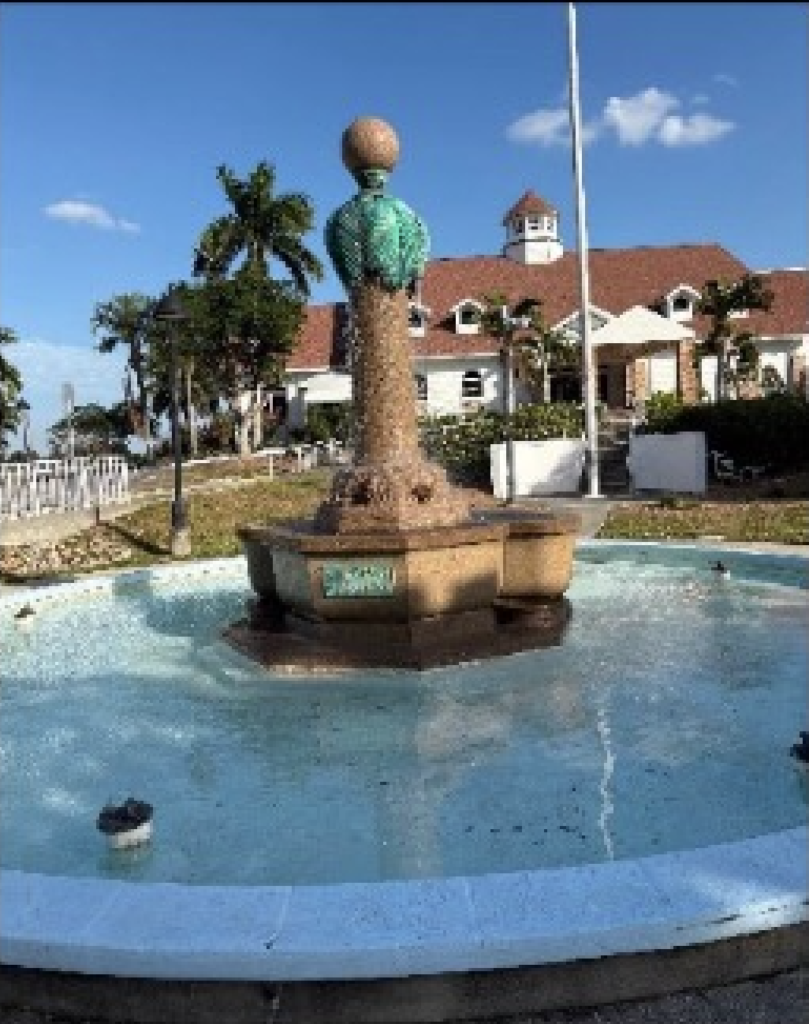
This piqued my interest in the whole Tootie McGregor story, so I got with my new buddy, Chat GPT, and found quite a story. Several things I found will certainly cloud a couple of local theories.
Let’s start with the players.
John D. Rockefeller was born in 1839. He moved to Clevland when he was 16 and got a job as a bookkeeper for an agricultural brokerage firm. He learned the business of finance. In 1859, Edwin Drake drilled a 69-foot-deep well near Titusville, Pennsylvania, demonstrating that oil extraction could be commercially profitable. Thousands came overnight. The town with the wonderful name of Pithole grew to over 10,000 people in months. Oil wells everywhere. This got John D.’s attention, and in 1863 he put together a partnership to invest in oil. He was 24. He realized the real money was in refining, shipping, and selling product. In 1866 he bought out his partners and established Standard Works.
Ambrose McGregor was born to a middle-class family in Cleveland in 1842. His father made barrels. Ambrose joined his father in the business. He was 17 when Drake found oil. Oil went from Pennsylvania west to Cleveland in barrels because the financial capability to build refineries was in Cleveland. John D. probably already knew the McGregors, and he began to purchase barrels from them. He learned that Ambrose was hard working, intelligent and knew how to make business deals. Ambrose was probably better than average looking and by the size of his neck, well-built. Just the kind of guy John D. was looking for to install into the middle of his business. He hired Ambrose in 1868 and made him a foreman.
Jeruda “Tootie” Barber was born in Cleveland in 1843. Her father was a judge and a well-respected lawyer, with social status, but not much wealth. His father had accumulated considerable wealth previously in real estate, but most of it was gone. It is written that Tootie and her sister often feared financial instability. Tootie and Ambrose grew up in the same general area of Cleveland, and they probably knew of each other. When it came time for Tootie to think about marriage, Ambrose would present himself well before her father when he asked for her hand. Plus, he had a friend, John D. Rockefeller. Tootie married Ambrose McGregor in 1867. He was 25, she 24. Their only child, Bradford, was born in 1868.
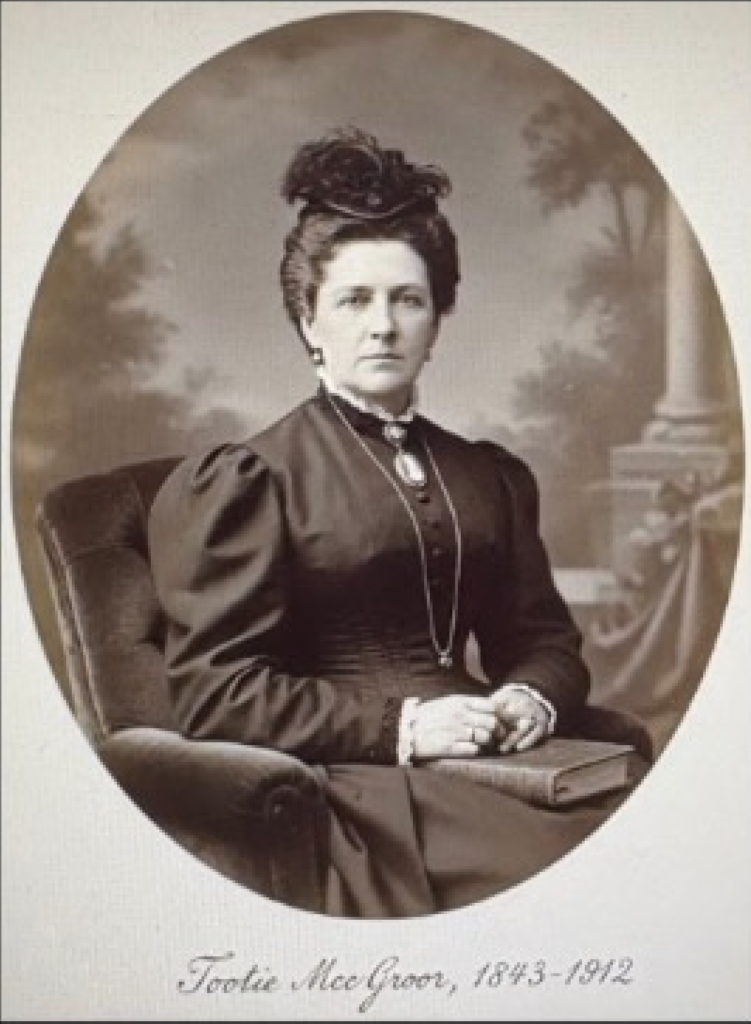
Marshall Terry was born in Waterville Center N.Y. in 1848. His family first moved to Plymouth, Ohio, when he was two, and later to Ashtabula, Ohio. Both are over 55 miles from Cleveland. It seems that he returned to Plymouth to attend Plymouth Academy. Marshall then went to medical school in Cleveland, getting his M.D. in 1872. There are local stories that when Marshall married Tootie many years later in 1905, after Ambrose passed, that they rekindled a teenage romance. “Teenage” does not fit because that requires Tootie to be no more than 19 and Marshall 14. He was most likely in Plymouth. Another story has Marshall as a young medical student, but with no means, so he left. I have a hard time with this because the earliest Marshall could arrive in Cleveland was when he was 17 and she was 22. There is nothing on the Internet to support he got there sooner. The events would have needed to occur quickly, as Ambrose would have been involved by 1866. Tootie’s picture indicates she was attractive and well founded. Being interested in a boy seems far-fetched. Maybe he had a crush, maybe she may have thought him charming, but more than that in 1866 seems doubtful. It made a good story in 1905. What we do know is after Marshall received his M.D., he moved to Utica, N.Y., where he became a prominent physician. In 1895 he became the surgeon general of N.Y. He served in the Spanish-American War. There he investigated the cause of Typhoid fever. He determined it was spread by flies, a controversial finding. After the war, President Mckinley offered Marshall a higher job, but he chose to return to N.Y.
Ambrose and John D. were more than associates. They were friends close to the same age. They often had lunch at a local boarding house. They had to sit at separate tables because of their dirty coveralls and oil on their shoes. Ambrose quickly ascended the management cycle. John D. likely made Ambrose an early stockholder as he often rewarded his closest associates with stock instead of salaries. Ambrose and Tootie began their marriage in an apartment over a store. There are reports of her darning his socks to save money, which are probably true. She also had Bradford to take care of, and he was not a hearty child. The apartment situation did not last long because things moved fast for Ambrose. Standard Works was dissolved and became Standard Oil in 1870. Book value was $1,000,000. If you could have just gotten in on that deal. As a trusted associate, Ambrose probably did. In 1872 John D. made Ambrose superintendent of all six Cleveland refineries. Also, in 1872 an event called the Cleveland Massacre occurred. John D. negotiated a deal with the railroads to receive rebates on his shipping rates. He used it to undercut his competitors and later caused them to accept his low offer, or operate under his control, or face bankruptcy. He soon gained control over most of Cleveland’s refineries. By 1878, Standard Oil produced 90% of the nation’s oil. As Ambrose rose through the company, he and Tootie rose through Cleveland social circles and lived in better residences. He also purchased real estate. One parcel was on Lake Erie, overlooking Cleveland, where they built a mansion.
In 1890, in search of a better climate for the often-ailing Bradford, they came to Fort Myers. They found what they were looking for, along with tarpon fishing. Earlier in 1885, Thomas Edison had purchased 13 acres on the Caloosahatchee River. He and his partner Ezra Gilliland planed the estate. They built two similar homes very close to each other. Problems occurred and they had a falling out. When the McGregors came down in 1892 the home was vacant and they purchased it for $4,000. Imagine a wealthy oil man and a world-famous inventor a sidewalk apart. Add two strong women in Mina Edison and Tootie, and while Mina was 20 years younger, imagine the conversations. Unfortunately, no record exists. Ambrose was involved with 30 local properties including a plantation and he supported Harvey Heitman in the development of downtown, all the while heavily involved with Standard Oil. Following a lengthy and successful career he became President of Standard Oil of Ohio in 1900, shortly before his death, most likely from cancer.
People wondered how much the estate was worth. Chat found a “News of the Day” item from those times. An attorney connected to the estate told a reporter, “More than $8,000,000.” That would be $300,000,000 today. Let’s look at it another way. 21 years later, in 1911, Standard Oil was forced to break up. Rockefeller owned 25% valued at $200,000,000. He subsequently owned 25% of the 30 or so companies created. Just two, Chevron and Exxon-Mobil, are worth $1 trillion today. Rockefeller’s share would be $250 billion. Given Ambrose McGregor’s significant role in Standard Oil’s operations, it is reasonable to assume that he would be worth several billion dollars today.
Tootie was one of the richest women in America. She was 57 years old and active. However, tragedy struck when Bradford died just 36 hours after his wedding to his young bride. Awful, right? Not over. Tootie chose to settle with the young woman for $2,000,000 just to keep her out of the estate when Tootie passed. Tootie was busy. In 1904 she helped fund Harvey Heitman’s construction of the Bradford Hotel, downtown. In Cleveland, she and her sister converted the Lake Erie mansion into a residence for elderly women. And who was donating medical equipment and helping? Dr. Marshall Terry. Tootie and the Doctor became close and were married in 1905 in the new Bradford Hotel.
In 1906 they acquired 40 acres east of town and with others, attempted to launch Fort Myers Yacht and Golf Club, but It was not successful. She funded Harvey Heitman’s development work in Fort Myers. In 1907 she helped rescue the troubled Royal Palm Hotel and may have even owned it for a while. She bought the Riverside Hotel. Dr. Terry’s New York home led to a New York / Fort Myers lifestyle. In 1912, Tootie told the City of Fort Myers and Lee County that she would pave the dirt road from Whiskey Creek to Punta Rassa if they paved the section from Whiskey Creek back to town and named the road after her. Some say she grew tired of taking a boat to the Tarpon House, at Punta Rassa, famous for catches of large tarpon. The city and county agreed, but unfortunately, Tootie passed later in August. Her estate was worth $3,000,000 and it all went to Dr. Terry.
Dr. Terry was a good soldier. He proposed a monument honoring Tootie at the downtown intersection of several roads including the beginning of McGregor Boulevard. He purchased the monument and it was placed in 1913. During the 1960s, when the Caloosahatchee Bridge was constructed and the intersection beneath was modernized, the monument was moved to Fort Myers Country Club. Dr. Terry also made sure the road work would go on. He purchased a barge and several large dump trucks to transport shell material to the roadbed and oversaw the construction. The road was completed in 1914. Meanwhile, Dr. Terry, who had never married before Tootie, advanced his love life, quickly marrying Adabele Merritt of Berkely, California, just eight months after Tootie’s passing. He lived most of the remainder of his life in a very social setting with her until he passed in 1933.
John D. Rockefeller outlived them, all passing in 1937 in Ormand Beach, Florida, at age 97. That marked the conclusion of one of Fort Myers’ most notable Gilded Age stories.
Back to the monument. Local sources speculate the granite in Tootie McGregor’s monument came from Georgia. Better research would have revealed one of the country’s two best granite quarries was in Westerly, R.I. It seems to reason Dr. Terry, recently made very wealthy through Tootie’s estate, would want the best.